FAQs
All FAQs
A band is performing my songs. Can they do this without my permission?
Yes, in most cases they can.
The venue in which the band plays must hold a OneMusic licence if they will be playing our members' music. It's not the band's responsibility to obtain a licence to play. A OneMusic licence gives the venue a blanket licence to authorise the performance of all OneMusic New Zealand's music (which is the vast majority of commercially available music from around the world).
Am I seeing all search results?
Certain works might not be available through the work search due to administrative reasons. If you can't find what you're looking for and are a music customer please contact Media Licensing; for music creators, contact Member Services.
Are there any discounts available when licensing music for advertising?
Campaign discounts apply if you are producing a series as part of one advertising campaign, across all broadcast mediums and territories, provided they are all licensed at the same time. (20% for 4-6 ads in the campaign, 25% for 7-9 ads in the campaign 30% for 10+ ads in the campaign)
Can a Copyright Owner control the use of particular works or catalogues in a Dramatic Context?
Your agency appointment to APRA provides you with great flexibility in the use of works in a dramatic context. You are able to define at a granular level where you want APRA to license, where you want to license directly and where you don’t want works used at all.
And remember, the Agency Appointment is non-exclusive, and Copyright Owners are can always license a production directly.
Can I alter the lyrics or write arrangements of a song?
Making lyric changes and arrangements of musical works are not covered by an APRA AMCOS licence. If you plan to alter lyrics or make new musical arrangements, you must obtain permission from the relevant copyright owner (usually a music publisher) or the songwriter, if the musical work is unpublished.
APRA AMCOS will supply you with publisher contact details to obtain permission direct.
Can I authorise a representative to help manage my membership?
As a writer member, you can authorise your manager(s), business associates, or other trusted individuals to have access and/or receive documents and correspondence on your behalf.
There are three levels of access: Full, Claim & Register or Financial.
Authorisation and any subsequent cancellation can be done in the Writer Portal or via a form.
Can I change my Restricted and Go-Direct lists?
While you may change these lists from time to time (in good faith having regards to administrative burden) any change cannot ‘undo’ the grant of an existing licence by APRA.
Can I change my song or work after it is registered?
You can make updates to the duration of a work, as well as add a new ISRC or Alternative Title via the App or Writer Portal on the web.
Just click on the work you wish to update and you can make changes by clicking Edit or + next to the relevant part you're updating.
To make changes to titles and/or the splits on a work, you will need to reach out to our Works Registration team.
In order to change other information on a work registration we need an email request, to be processed by our Works Registration team.
Please send the following information to [email protected]
- The current work title
- The work's WorkID (normally starts with GW)
- Your name
For any element(s) you wish to change (such as titles or splits):
- What we currently have, and
- What you want it changed to
Please cc any co-writers into this email, for major changes we will need all co-writers to approve.
Can I claim royalties for a remix?
You may have been given permission to create and release a remix but this does not necessarily entitle you to register the remix with APRA AMCOS and claim royalties.
It is quite common for the owner of the original song to provide permission for your remix to be commercially released so long as they retain the copyright in the remix. In this instance, the royalties for the remix will be paid to the songwriter and music publisher of the original song.
If you wish to claim a share of royalties for your remix, you will always need to obtain the written permission from the owners of the original song. The original owners may be songwriters, music publishers or both. If permission is granted for you to claim a percentage of royalties for your remix, you should email us a copy of this permission along with your remix registration details.
Can I earn royalties from airplay on online radio and digital radio stations?
Yes. The majority of New Zealand and Australian online and digital radio stations are simulcasts of their analogue versions, and this additional use is licensed under their standard APRA AMCOS agreements.
Can I earn royalties from digital downloads and streamed music?
Yes. Remember to register your works.
Digital royalties are paid out in our quarterly distributions. Writer members do not need to do any reporting, just register your works! However, adding ISRCs to your work registrations does assist us greatly.
We have licence agreements in place with most legal digital service providers (eg: Spotify, Apple Music). Traditionally, we would expect royalties to be paid out 6 months after streaming or download in New Zealand or Australia - depending on the reporting and processing lead times. Overseas royalties do take longer, as they must first be processed by our international affiliate societies. This can take 12-24 months, depending on the territory.
Can I earn royalties if my music is played by a webcaster?
Yes, but keep in mind that the licence fees we collect from webcast services are a fraction of what we collect from commercial radio stations. Given the vast number of hours of music programming and the significantly lower licence fees we collect, the royalty distributions for streams by webcasters are incredibly small.
Can I earn royalties if my music is used on YouTube?
Yes. Our licence agreement with YouTube covers the streaming of all music videos including music embedded in User Generated Content (UGC).
You may find that your works have been being synchronised as part of other users’ uploaded content to YouTube. It is important to understand that the synchronisation rights of a work are owned by the original copyright owner/music publisher. Therefore, a work cannot be used without gaining permission from the copyright holder (that means you or your publisher!).
If you discover that your musical work has been used without your consent, there are two options available:
- Contact the user who has used your work and license them directly.
- Contact us and we will endeavour to have the video taken down from YouTube on your behalf.
Please note, if you want to upload cover versions of songs to a User Generated Content site (UGC) where a visual element is present (YouTube, Facebook, Instagram, TikTok etc), you may need to clear the synchronisation rights with the music publishers/original copyright owners.
Can I enter a song I have co-written with somebody else?
Yes, as long as you have their permission to do so, and at least 20% of the song was written by a New Zealand APRA member.
Can I enter more than one song/work?
In certain cases yes.
In regard to the APRA Silver Scroll Award – only one work may be submitted by or on behalf of any one writer, except in the case of co-written songs, where a writer may be included in entries for each separate writer/band/artist that they collaborate with.
In regard to the APRA Maioha and SOUNZ Contemporary Award – a maximum of two works may be submitted by or on behalf of any one writer, except in the case of co-written works, where a writer may be included in entries for each separate writer/band/artist that they collaborate with.
In regard to the APRA Best Original Music in a Feature Film or Series awards – a maximum of three entries may be submitted by or on behalf of any one writer.
A separate entry form is to be completed for each work submitted.
Can I enter my song/composition in more than one category?
The short answer is yes. You can enter the same song for the Silver Scroll Award as well as the Maioha Award, or you can enter different songs in each category.
While it is unlikely that a work which is eligible for the SOUNZ Contemporary Award | Te Tohu Auaha will also be eligible in other categories, there are no rules which explicitly prevent the work from being entered in other categories also.
In regards to the Screen Awards, the music must have been written specifically for inclusion in the feature film or series entered.
Can I have more than one Successor in Title (SIT)?
Yes. There is no limit to the number of SITs you can have your royalties paid to. For example, if you have 4 children your royalties can be paid 25% to each of them or any other percentage as detailed in your will.
For more information, or to request an application form, please send us an email.
Can I use one form for all my releases?
No. You are required to complete one form per release.
Do I have to be an APRA member?
If you are not already an APRA member, you can apply to become an APRA member in order to enter your work. Our member services team are happy to help you with this.
Do I need clearance to upload other people's music?
APRA AMCOS has a licence agreement in place with YouTube. The licence does not extend to synchronisation (the initial reproduction of the song when making the video).
Our recommendation is to first contact the song’s ccopyright owner – often a music publisher. This will identify if a clearance is required to make a synchronisation of the song in a video.
Do tag end change discounts apply when licensing music for advertising?
Where a series of advertisements are produced, and the variation is the end line 'tag ending' (e.g. 'starts Monday, starts tomorrow') the licence may be charged at 50% of the applicable rate, multiplied by the number of versions. This concession is only granted for tag changes on ads licensed for the same broadcast area and approved by the Production Music department.
Do you guarantee the accuracy of the results?
The results you see are pulled from the details in our system at that given point in time. Some details change intermittently when registrations from publishers and writers are added to works. For this reason, we can't guarantee accuracy as the details may change between your search and any licensing activity that takes place after this. If you have any further questions, please get in touch.
Does copyright apply on the internet?
Many people assume that material on the internet is copyright free, but it's not. It's protected in the same way as material available through other more traditional channels. A song stored as an mp3 on a website or a track on a music streaming service is protected in the same way as a recording on a CD. If you want to copy that CD, play it in public or communicate it to the public (eg: by broadcast or via the internet), you need permission from the copyright owner. Similarly, you also need permission if you want to download the mp3 file onto your own computer, make a copy for a friend or put it on another site.
The Copyright Act states that a person who authorises a copyright infringement may also be liable for that infringement. A website operator may therefore be liable for any infringements that occur as a result of users of their site uploading or downloading their material. The New Zealand courts have held that a person who sanctions, countenances or approves of an infringing activity may be liable for authorising that activity.
Does it matter whether my song has been popular or successful?
No, not at all. All categories in the APRA Silver Scroll Awards are judged solely on the artistic and creative merits of the song.
Does my APRA AMCOS licence cover the use of a digital (streaming) music service in my business?
According to their Terms of Use, personal/non-commercial digital music services like Spotify can only be used for personal and domestic purposes. However, whatever the source of the music used at your organisation or business, if you use APRA AMCOS' music then you’ll still need a licence from us to play it in your business.
In addition, if you copy APRA AMCOS' music, for example from one CD to another, or you stream it from a personal/non-commercial digital music service, such as Spotify, then you’ll also need coverage called “Digital Copy/Delivery".
You should be aware that an APRA AMCOS licence, even when it includes Digital Copy/Delivery only gives you permission to use APRA AMCOS' music in your business (or event); it does not override the Terms of Use for the personal digital music service you are using, nor does it give you permission to use that particular music service for a commercial purpose – that permission can only come from the owners of that service.
You may be better to consider a commercially licensed streaming service. Apple Music for Business subscribers are subject to separate Terms of Use, which do permit the playing of music in a commercial space. These terms are completely independent of the terms applying to Apple Music’s personal/non-commercial digital music service.
Does my licence include online clearance?
All Production Music rates include reproduction clearance for transmission by digital platforms. If you are the website owner you will also need a communication licence from us, contact [email protected].
How are the finalists and winners decided?
For the APRA Maioha Award, SOUNZ Contemporary Award | Te Tohu Auaha, and Screen Awards, we assemble a judging panel of fellow members who have expertise or experience in each respective category. The names of these judges are published each year. They take time to consider all entries and create their own shortlist before coming together to discuss which entries will become finalists and winners.
For the APRA Silver Scroll Award, we assemble a panel of ten APRA members/songwriters as our initial judging panel. They listen to all the entries (often more than 200 songs) and create a shortlist, before we hold a panel meeting to decide on the top 20 songs. The names of these judges are also published each year.
For the APRA Maioha Award a separate judging panel listens to all Maioha entries and votes for their Top 5 waiata.
All APRA members are then invited to listen to the Silver Scroll Award Top 20 and vote for their top five songs in order. Members are also invited to listen to the Maioha Award Top 5 and vote for their top three songs in order. These votes determine the shortlists and winners for both awards.
All judges in all categories evaluate the entries without knowing who wrote/composed each song/work – they are simply given the song title, song lyrics, and audio file.
All judges have not entered the awards themselves and must declare any conflict of interest with any entries ahead of final decisions being made.
APRA staff members have no input or influence in the judging of any categories.
How can I find out more about the search results?
If you require additional information about certain works, please contact us. We're here to help.
How can I find the music I want?
This is an important part of understanding how Production Music licensing works. All our Production Music Suppliers provide a music works search. Be sure to provide them with a detailed brief of what you are looking for and they will provide you with several options.
How can I resign my membership?
To cease your APRA membership all you need to do is contact us to let us know.
We will be in touch to confirm the circumstances of your resignation so that we can make the necessary updates to our records, including changes to your songs’ registration details and timelines around when we should cease licensing your songs and distributing royalties to you. You will receive a letter of confirmation once your membership has ceased.
There is standard six-month notice period for resignation of membership, after which you will cease to be a member on the earlier of 30 June or 31 December. Ending your membership sooner may be possible in the appropriate circumstances, on request.
If you have any questions about resigning your membership, please contact us.
How do I collect this information?
Selling CDs in person (markets, fairs, workshops)
At the point of sale, you will need to ask the customer, “Will this CD be used as part of a business?” If so, please document the customer’s details (business name, contact name, contact phone, contact email and address) as required by the ambient music reporting form. If you can't get this information, then you can't report the use of the CD.
Selling online (PayPal and artist’s own online store)
We recommend selling your ambient music through your own website and require the customer to provide an email address and/or business information. If you can't get the business information at the point of sale, we suggest you generate an automatic email for your customer/s requesting business information. Remember that without this business information, your ambient music reporting form will be ineligible.
How do I copyright my songs?
Good news! Copyright for your original music is free and automatic as soon as it's written down or recorded in some way. APRA AMCOS acts as a link between those who create and own this copyright material, and those who want to use it.
How do I find my member number?
To locate your member number, you can:
- Log in to the Writer Portal > from the Dashboard > click Account
- Open your APRA AMCOS App and go to Account; it is also on your digital Member Card
- Find it at the top of your Statements that we email to you
How do I get an IPI number?
When you become an elected member of APRA AMCOS an 11 digit IPI number will be assigned to you.
You can find your IPI in the app or Writer Portal in your Account . You can also find your IPI number in the acknowledgement of membership email you receive from APRA AMCOS once you've become a member.
How do I join my band up to APRA AMCOS?
The copyright in a song is owned by the individual who wrote the song. For this reason, only individual songwriters can join APRA AMCOS. A band cannot sign up as a single entity. If all of your band members write songs or collaborate to write songs, then all band members can individually join APRA AMCOS as members.
If you are in a band, when you complete your APRA AMCOS membership application, make sure you tell us your band/performer name.
When registering works that have been co-written, you'll need to tell us the names of the other writers and the ownership percentage splits for each of the writers. It's important that all songwriters within the band agree on the percentage splits for each work before registering the work with APRA AMCOS, otherwise this can lead to problems down the track when royalties may become payable for that work.
Each song co-written by the band only needs to be registered with APRA AMCOS once. The band should agree on who will take responsibility for registering each work and providing the songwriter and ownership split details. If more than one writer registers the song and there are differences in the details provided, this can make it harder for us to track the use your music and pay royalties correctly.
Only the musical work copyright owners (ie the songwriters and the music publisher if applicable) should be credited in the APRA AMCOS registration.
How do I log in to the Writer Portal?
In the 'Log in' menu on the website, choose 'Songwriters and composers' and then log in to your account. Enter your email address - the one you use for APRA AMCOS correspondence.
If it's your first time logging in, follow the steps to set up passwordless login.
What is passwordless login?
We use a simple, secure method to log you in – no passwords required. Just enter your account email and we will send you a one-time code. You can also log in with a passkey (Face ID, fingerprint, or your device unlock).
How do I obtain permission to release a remix commercially?
You usually need to clear both of the following copyrights to commercially release a remix:
- the copyright in the composition (i.e. the musical work – music and lyrics); and
- the copyright in the sound recording (sometimes referred to as the master)
We can help you contact the copyright owners of the musical work. These will be songwriters and/or music publishers.
To find out the sound recording copyright ownership details, please Recorded Music NZ for more information.
How do I register works commissioned specifically for a film or TV production?
If your works have been commissioned for a film or TV production, that is, if they make up all or part of the overall sound score (the underscore), you'll need to register them using a different format than general works.
A "cue" refers to when and where a piece of music is used in a film/TV production. There are two types of cues that can be registered with APRA AMCOS - background and theme.
You do not need to register all individual cues. Simply register one work for all of the background cues and one work for the music played over the opening/closing credits (if applicable).
Use this format to register: "EXAMPLE TV SHOW (BACKGROUND)" and "EXAMPLE TV SHOW (THEME)".
If a pre-existing work is used in a film or TV production, register it as a general work, not as a background or theme.
How do I search for a work?
- In Search, choose the 'works only' option.
- Enter the title of the song or composition in the 'Title' field.
- If you know who the writer is, enter the writer's surname only (not their first name) in the 'Writer' field. If you don't know who the writer is, leave it blank.
- If you know who the performer is, enter the performer's name in the 'Performer' field. If you don't know who performs the work, leave it blank.
You can't search by writer alone. Performer or title is required.
How do I update my membership details?
Head to the Writer Portal or access the APRA AMCOS for Music Creators app (download for free from the App Store for Apple devices and on Google Play for Android) to update personal information like bank account, email, or phone number. Need help? Use our handy guide.
Some details, such as a change of legal name, can only be amended via email at [email protected]
How has the definition of the APRA Festival licence changed?
Effective 1 December 2023, the APRA definition of a Festival will be as follows.
Festival being any music event, tour, festival or concert with a compulsory fee charged for admission and which meet all of the following criteria being an event:
- that occurs on at least one full day (being no less than 8 hours in advertised duration); and
- that is held at a place requiring temporary infrastructure to be constructed specifically for the purposes of the event, including as a minimum:
- the construction of performance areas/stages; and
- the presence of temporary perimeter fencing or controlled access by other temporary means; and
- the provision of toilet facilities and a clean water supply; and
- in which the staging of the event and all associated advertising is not dependent on any one or two advertised acts; and
- that includes at least six advertised acts.
How have CPI increases been calculated 1 July 2022
On 1 July each year APRA’s GST exclusive rates are increased by the percentage increase in the CPI between the last two March Quarter’s under the Licence Agreement terms.
The increase in the CPI between the last two March Quarters was 6.9%.
At APRA we are aware of the challenges businesses face as we begin to see light at the end of the tunnel from Covid-19.
To support businesses as well as our music creators we’ve made a one-off decision to discount part of the increase that would otherwise apply for the year commencing 1 July 2022 licences below.
The GST exclusive rate for the following licences will effectively increase only by 3.9%
(with APRA discounting the remaining 3%).
This discount on the increase under the Licence Agreement terms is being implemented only in respect of the licence year commencing 1 July 2022.
How have CPI increases been calculated 1 July 2023
1 July 2023 Consumer Price Index (CPI) Notice.
On 1 July each year APRA’s GST exclusive rates are increased by the percentage increase in the CPI between the last two March Quarter’s under the Licence Agreement terms.
The increase in the CPI between the last two March Quarters was 6.7%.
APRA are aware of the challenges businesses face and to support them, as well as our music creators, we’ve made a one-off decision to discount part of the increase that would otherwise apply for the year commencing 1 July 2023 licenses below.
The GST exclusive rate for the following licenses will effectively increase only by 4%.
(with OneMusic discounting the remaining 2.7%).
- APRA Cinema Licence
- APRA Community Bands, Group, Choir Licence
This discount on the increase under the Licence Agreement terms is being implemented only in respect of the licence year commencing 1 July 2023.
How long do I have to pay my invoice?
You have 14 days to pay.
How long does my licence last?
All APRA AMCOS Controlled Production Music licences are cleared in perpetuity, which means there's no time restriction.
How much does it cost to enter?
It’s FREE to enter all the categories, so all it will cost you is a couple of minutes of your time.
How was the potential revenue ‘damage’ calculated for the AI report?
- The report used a range of internal and external data and projections to estimate the economic impacts WITH and WITHOUT action in response to Generative AI.
- Each category of music copyright revenues (e.g., for streaming, social media, radio, TV, live music, background music in commercial venues) was assessed for the potential risk of being replaced by Gen AI.
- 23% is the estimated amount of music creator revenue that is at risk if no action is taken in Australia and New Zealand. In Australian dollar terms, this equates to approximately $227m out of a potential $986m in 2028.
(Note, this estimation does not factor in any potential renumeration systems for music creators with respect to Generative AI inputs and/or outputs.) - For more information, see pages 6, 10, 75 and 76 of the report.
I have a dispute with a co-writer over a work. Can APRA AMCOS help me resolve this?
We have a process for handling disputes between members, for example, if you and another writer disagree on the ownership percentage of a work that has been registered with APRA AMCOS. Please please send a short message via the Contact Us page in the first instance.
Our writer services team will contact the member and see if the dispute can be resolved between the parties. In some instances, we might recommend the dispute be referred to the independent third party alternative dispute resolution facilitator, Resolution Pathways. You can find out more about this process on the Resolution Pathways website.
When working with co-writers, it is best to have a clear written agreement that states the nature of your collaboration.
I have already paid for the music. Why do I need another licence?
The ‘reproduction’ of the musical work into the original production is what you've most likely paid for. This fee would have been for the specific purpose of making the advertisement, audio-visual program or radio promo - not for the purpose of showcasing your work as an agency, a director, editor, producer, creative, and the like.
In most cases the original licensing of music in these productions only covers the agency for the reproduction. Our Showreels licence covers the communication of musical works online. It does not cover rights you may have previously paid for.
I just joined as an APRA AMCOS writer member, do I need to join as a publisher member as well?
In most cases, no. You should only join as a publisher member if you are intending to administer, promote and commercially exploit the work of other writers. Music publishers require in-depth industry knowledge and experience, as well as legal contracts in place with songwriters. Find out more about what a publisher does.
Learn more: I'm a new member, now what?
I missed out on submitting my ambient music reporting form for a previous year. Can I still get paid?
The retrospective claim period for ambient music is one year. It may be extended to up to three years where appropriate extrinsic evidence (i.e: going beyond a mere claim supported by a statutory declaration) is provided in support of the claim. It will be credited at the rate applicable to the distribution in which it is paid.
I want to make a CD that includes covers of other people's songs. Do I need a licence? What about if I want to make it available on a digital service?
Yes. You will need to obtain an AMCOS licence if you want to make a recording of a song composed by another writer. Find out more in Making Recordings.
Uploading cover versions to digital service provider sites like iTunes, Apple Music, Spotify etc.
USA
If you are recording a cover version of a work and wish to sell it as a digital download on a US-based download service, you are required to take out a licence with the Harry Fox Agency (AMCOS equivalent in the USA). Go to www.harryfox.com and head to their Songfile Mechanical Licensing tool. In cases where the Harry Fox Agency do not represent the work, you may be able to obtain a compulsory licence via RightsFlow – see www.rightsflow.com and head to the Limelight licensing area.
New Zealand
As long as you've first obtained a manufacturing licence from AMCOS, you can supply your recording to a digital service provider (DSP) such as iTunes, Apple Music, Spotify etc. APRA AMCOS licenses DSPs directly, and so royalties for downloads will be collected by APRA AMCOS on behalf of the rights holders.
I'm in a band. How do we split royalties?
Ideally you work it out song by song, as it probably won’t be the same for all songs. You'll need to do this before you register the song with APRA AMCOS.
This is easy, for example, if one person wrote 100% of the lyrics and the other wrote 100% of the music. When you’ve written a song with others, it’s a good idea to have a written agreement that talks about the share of copyright you each take.
I’ve submitted my Performance Report. Now what?
Once you’ve submitted your Performance Report, it will show at the bottom of the ‘Submissions Overview’ tab of the Portal/App. The submission date is shown, along with the month in which the royalties will be paid.
Performance Reports marked as ‘Active’ can still be edited - so if you forgot to add the songs from the encore, you still can!
The ones marked as ‘Processed’ have been locked and are being readied for payment.
The processing of Performance Reports generally takes about six months from the date of entry to when your royalties are paid out.
During this time:
- the reports are checked for veracity,
- all works performed are matched against the work registrations database to identify the composers,
- the composers are connected to their RMO - be that APRA AMCOS or one of our foreign affiliates (or recognised as “non-members”),
- licence fees collected from live performance venues are divided amongst the number of writers to be paid
- and finally the payment for each writer is paid out in the next upcoming quarterly distribution (February, May, August & November).
If I commissioned the musical work for the production, am I already licensed?
In most cases tracks are commissioned solely for the reproduction (i.e. to be used in an ad). The composer/publisher still owns the right to the communication of the work, which APRA AMCOS administers. In this case you will still need to take out the showreel licence to cover you for the communication.
However if an APRA AMCOS member chooses to 'licence back' their work, they can deal directly with you for the licensing of the communication right. In such cases, the commissioned writer must contact APRA AMCOS to complete a 'licence back'.
If I complete and sign the Agency Appointment form, would APRA amcos have exclusive right to license my repertoire for Dramatic Context?
No, APRA AMCOS would be a non–exclusive agent. You can always negotiate a direct licence for the use of repertoire controlled by you in a dramatic context performance.
Is APRA AMCOS a government body?
No. We are a music rights management organisation that collects licence fees which are paid out as royalties to those who create the music – composers, songwriters and their publishers. The organisation was founded as APRA in 1926 (when radio first started in Australasia). APRA AMCOS is New Zealand's oldest copyright collecting society. Find out more about what we do.
Publisher vs AMCOS
AMCOS has reciprocal agreements with other affiliated societies around the globe – meaning you reproduction royalties are collected worldwide.
Some territories overseas require individuals to set themselves up as a Publisher or use a third-party music service to collect 100% of reproduction royalties, but as an AMCOS member you do not need to do this.
If all your songs or compositions are published, your music publisher will collect your reproduction royalties, and there's no reason to join AMCOS. AMCOS is primarily a royalty collection service and does not play the role of a music publisher. Find out what a music publisher does.
Should I register my musical work any differently than usual if I have used generative AI?
For copyright to exist in a work, it needs to be an original work created by a human. If you have created an original work with the assistance of technology, including generative AI technology, our current advice is that you may still register the work as usual, listing yourself as the composer/lyricist of the work. Remember the composer/lyricist shares of the work should total 100%
Should I submit a Performance Report if I perform at a Promoted Event?
If you’ve played at a Promoted Event*, the promoter will ask for your setlist and submit it to APRA AMCOS on your behalf. If the promoter doesn’t ask for your setlist, chances are your show falls into the general live performance category, and you can submit a Performance Report yourself in the App or Writer Portal.
*Promoted Events generally include major festivals, international tours and special events. These events are licensed differently to standard venues (bars, clubs, restaurants, etc).
Instead of going into a live performance royalty pool from venues across Australia who host live music, the licence fee for Promoted Events turns directly into royalties for those performing at the event. If in doubt, submit a Performance Report! If you haven’t been asked to provide a setlist, by the Promoter or by an APRA staff member, please submit a Performance Report for these events. This ensures you are paid for all your performances in New Zealand and Australia.
The music on my website is production music, which is purchased. Do I still need a licence?
The purchasing of Production Music only covers the reproduction of the musical works for the initial purpose i.e. to make an advertisement. It does not cover the purpose of highlighting an agency's work in a showreel - which in itself is a new form of advertisement – or the right to communicate the work to the public. When a production or showreel is communicated to the public (streamed) from a website – similarly to being broadcast on TV - the responsibility of licensing this communicated music falls on the content provider - in this case, the host of the website.
If you only have Production Music on your website, you may qualify for Tier One on the Showreels Licence ($100 incl. GST).
What about copyright in other countries?
Most countries have copyright laws similar to New Zealand. If your work is protected here, it will also be protected in most other territories. This is because most countries (including New Zealand) have signed international treaties and conventions requiring signatories to provide minimum standards of protection for copyright material from all countries party to the treaty.
New Zealand copyright works are protected in about 133 countries, including Canada , China , France , Germany , Hong Kong , Indonesia , Japan , Korea , Malaysia , Australia , Singapore , the United Kingdom and the United States . Similarly, works from these and other territories will also be protected in New Zealand. It is important to note, however, that the term of protection may differ in other territories, and you may wish to seek specific advice on this matter.
What about international royalties?
AMCOS has reciprocal agreements with the all the major mechanical rights organisations worldwide including organisations in the USA, UK, Canada. They do the mechanical licensing in their respective territories, collect the mechanical royalties on our writers' behalf, and distribute the royalties to AMCOS. We then pay the mechanicals to our writer members directly.
We generally advise writers to opt in for AMCOS to collect your overseas mechanicals. The alternative – to collect it yourself – can be difficult to achieve for unpublished writers.
What about music used at the end of the show, or during curtain calls or bows?
Music used pre-show, intermission or post-show while the house lights are on is generally not considered to be Dramatic Context and may already be covered under a venue’s OneMusic licence for background music.
Music used during an encore, curtain call or bows is always Dramatic Context.
What about the recording quality? Does my song have to be professionally recorded, or can it be a demo recording?
The quality of the recording is not taken into account by the judges, so it can be recorded however you like. However, your song must have been released to the public in some way in order to be eligible (ie. made public via a digital platform like Spotify, Apple Music, Soundcloud, YouTube or another website, or via radio or TV).
What are Performance Reports?
If you play live at pubs, clubs, cafes, or other live music venues in New Zealand and Australia, you can get royalties for these performances by submitting a Performance Report.
Just tell us what songs you've performed in which venues, and you could be paid for playing your original music live. Please make sure you also tell us about any covers you perform so the original songwriters can get paid too.
You can submit your Performance Reports on-the-go via the APRA AMCOS for Music Creators App or in the Writer Portal. Download the app for free from the Apple App store, or from GooglePlay for Android.
What are the rates paid for YouTube videos?
Revenue from YouTube depends mainly on popularity and CPM (cost per thousand). CPM rates on YouTube generally range from a few dollars to around $20. Some premium content videos can fetch CPM’s of up to $60.
Using a CPM rate of $10 for a video with 1 million views – the calculation would be: $10 CPM x (1 million views /1,000) = $10,000. Reports indicate YouTube keep approximately 45% revenue so the video would receive around $5,500 split between the rights holders. If the video met APRA AMCOS distribution criteria, then musical works would also earn royalties.
What are the risks of playing music at a political event?
Political parties should be aware of the complexity and risks involved when using music for political purposes at events and in video, whether on social media or in advertising.
Our Political Parties Guide to Music Licensing sets out risk management factors that political parties and political organisations should consider before using music for political purposes.
What determines the live performance royalty amount?
Are the earnings the same if I play at the corner pub vs a 500-capacity room?
If you are not performing a Promoted Concert or Event (see above for an explanation), your live performance royalties will be the same if you are playing at a corner pub or a 500-capacity room.
Let’s explore what determines the live performance royalty amount.
Each venue (like a bar, club, restaurant, etc) that hosts live music is required by law to purchase a OneMusic licence.
The cost of the live music licence is based on either the amount the venue pays to musical acts or a percentage of ticket sales.
All the live music licence fees are collected in a ‘pool’ and the collective amount is distributed across all of the live performance submissions we receive.
For more information check out our Live Performance distribution information guide.
What do I do if I have a concern or complaint about APRA AMCOS?
We care about the service we give you and we welcome your feedback.
- If you would like to comment on our licensing service, email [email protected].
- To comment on our membership service, email [email protected].
- If you still have concerns after using our formal complaints procedure, you may wish to use our dispute resolution system. Email [email protected].
What do I need to do to show my work is copyright protected?
You do not need to register your work, pay any fees or fill in any forms for it to be protected. Copyright protection is free and automatic, both in New Zealand and overseas. As soon as you write down your lyrics or music, or record it in any format, it will be protected by copyright. The only requirement is that the work is original (ie: it is not copied) and the result of some skill or effort on your part.
You also do not need a copyright notice on your work for it to be protected. However, it is advisable to warn people that you own the rights in the work. The notice is the copyright symbol ©, your name (and the names of other co-creators), and the year in which the work was created or published. For example: © John Brown, Jenny Black, Jackie Green 2008. You should mark all copies (print and recorded) with this notice.
It is rare that disputes arise about who owns the copyright in a work, but if this occurs, you do need to be able to prove that you created the work. The best evidence of this would be early drafts or recordings of the work as well as diaries detailing its development.
What do I need to know before I release a remix I created, but that I don't have permission to claim copyright for?
Anyone can create a remix of a work at any time. However, if you wish to claim a royalty on your remix or you plan to release your remix commercially, you must always gain written permission from the original copyright owners of the composition and the sound recording.
If a remix does not include additional original composition, and the song has had a previous commercial release, it may be that the making of the remix is covered by the statutory mechanical licence provisions of the Copyright Act. In this case, separate additional clearances from the owners of the musical work are not required to create the remix so long as the physical or digital release of the recording is licensed by the copyright owners, and you have permission from the owner of the original sound recordings.
If you have not been granted permission to claim copyright in your remix but you intend to release your own CDs, provide digital downloads or streams, you should contact us for the necessary licences for the reproduction (and communication where applicable) of the original song.
If in doubt whether the statutory mechanical licence provisions apply to your remix, you should seek independent legal advice.
What does "AMCOS controlled %" mean?
This shows the percentage of the work directly controlled by AMCOS. If AMCOS doesn't control 100% of a work you wish to license, you may need to contact a writer or publisher directly for approval. This total may include shares attributed to writers/publishers represented by AMCOS, OR writers/publishers represented by a foreign mechanical collection society that has a reciprocal agreement with AMCOS—where we collect on their behalf.
What does a Publisher do?
Music publishers nurture and develop songwriters and composers, and take care of the business aspects of their career. Music publishers make an investment - in terms of money, time and experience - in their writers. They exploit the copyright in the music and songs created by their writers in order to make a return on that investment, and to reward the writers for their creative work.
What does APRA AMCOS do?
APRA AMCOS grants licences for the live performance, broadcast, communication, public playing or reproduction of its members’ musical works. APRA AMCOS then distributes the licence fees to its 128,000+ songwriter, composer and music publisher members and affiliated societies worldwide.
APRA AMCOS is the trading name of Australasian Performing Right Association Limited (APRA) and Australasian Mechanical Copyright Owners Society (AMCOS).
What does it mean to make works or catalogues Go Direct?
Listing a work as Go Direct means it is available for use in a Dramatic Context show, but requires individual approval from the copyright owner. For works/shares on the Go Direct list, APRA AMCOS will direct the client to the Copyright Owner of the work for them to directly license it.
What does it mean to make works or catalogues Restricted?
Listing a work as Restricted means you do not allow the work to be licensed in a Dramatic Context show. For works on the Restricted list, APRA AMCOS will advise the client that the work is not available to be licensed Dramatic Context, and to choose another work.
What format do Production Music tracks come in?
Various formats of over 1 million tracks are available in the form of single files and hard drives.
What happens if I don't get a licence?
Services that use copyright music without first obtaining a licence from the relevant rights holder may be infringing on their copyright. This could lead to the individual or business being subject to legal proceedings for copyright infringement.
What happens if I'm not an APRA AMCOS member at the time of my death?
The Successor in Title (SIT) application process is the same, we just enter the songwriter’s details posthumously into our system as if a new member.
For more information, or to request an application form, please send us an email.
What happens to my royalties when I pass away?
In New Zealand, copyright exists until 50 years after a songwriter’s death. APRA AMCOS can arrange to have any future royalties generated by your musical works paid directly to a person entitled to receive them until that time (usually the beneficiary of your estate). This person is referred to as a Successor in Title (SIT).
Who can I contact for further information?
For an application form or to find out more, contact [email protected], 09 623 4718.
What if I composed the music on my website?
As an APRA AMCOS member you have granted us the exclusive right to administer the communication of your musical works. However, you can opt to "licence back" your works for a specific purpose. If this is something you would like to pursue, please contact our Writer Services team at [email protected].
In cases where you may have co-written a song, all writers must agree to license back that work, before any direct dealings can take place regarding the communication right.
For any musical works on your website that you didn't compose, you will still need to take out the showreels licence for the communication of these works.
What if I think a business is using music without a licence? Who can I advise?
All businesses that use our music should have a licence. If you believe that a business is using music without the appropriate licence, please contact OneMusic on 0800 800 663 or [email protected].
What if my territory isn't listed?
APRA AMCOS can license any territory required, provided the production is being produced in New Zealand or Australia. Please contact us for specific territory rates.
What if the music is 'buy out library' or 'royalty free' music?
‘Royalty free’ and ‘buy out library’ music may still need to be licensed. Composers rarely give up all their rights when you purchase a buy out library. In most cases, this music has no ‘reproduction’ rights attached (i.e. anyone can reproduce the music into an ad), but they still retain their ‘communication’ right. If the composer is a member of a performing rights organisation (like APRA AMCOS), they have essentially given the performing rights organisation the right to administer the communication rights of their works. In these instances, additional licensing by APRA AMCOS, to communicate the track on your website is still required. Be sure to read the terms and conditions when you purchase any ‘royalty free’ music.
What information do I need to supply on the form?
You must include the following information about the release:
- Release title
- Titles of the works on the release
- Names of composers
- Work durations
- Total durations of co-written and solely written works on the release
You must also include details of the businesses that purchased the release including:
- Business name
- Contact name
- Contact phone
- Contact email
- Address
What information does APRA AMCOS need from my Successor in Title (SIT)?
The SIT needs to complete an application form, an electronic banking form and also provide us with:
- A notarised copy of the death certificate
- A copy of their ID, for example a drivers licence or passport
- A copy of the will (if there was one)
For more information, or to request an application form, please send us an email.
What is ‘Generative Artificial Intelligence’?
Generative Artificial Intelligence or Generative AI is a class of machine learning[i] that can create new content such as text, images, videos, music, and more.[ii] It is designed to generate new outputs in response to prompts (most commonly text, though this can include other media such as images, audio and video). It does this by analysing patterns in existing data sets to produce similar styles or structures.[iii]
In simpler terms, Generative AI is a technology that uses existing data, information and/or media in order to generate and deliver an output when prompted by a user. This technology can analyse the patterns, tempo, key and lyrics of existing songs in order to generate “new” music. When using these tools, a user may set or describe certain criteria, such as instrument, mood or genre, in order generate a particular output. A user could generate a variety of different melodies or lyric options that they then use as the basis of a song.
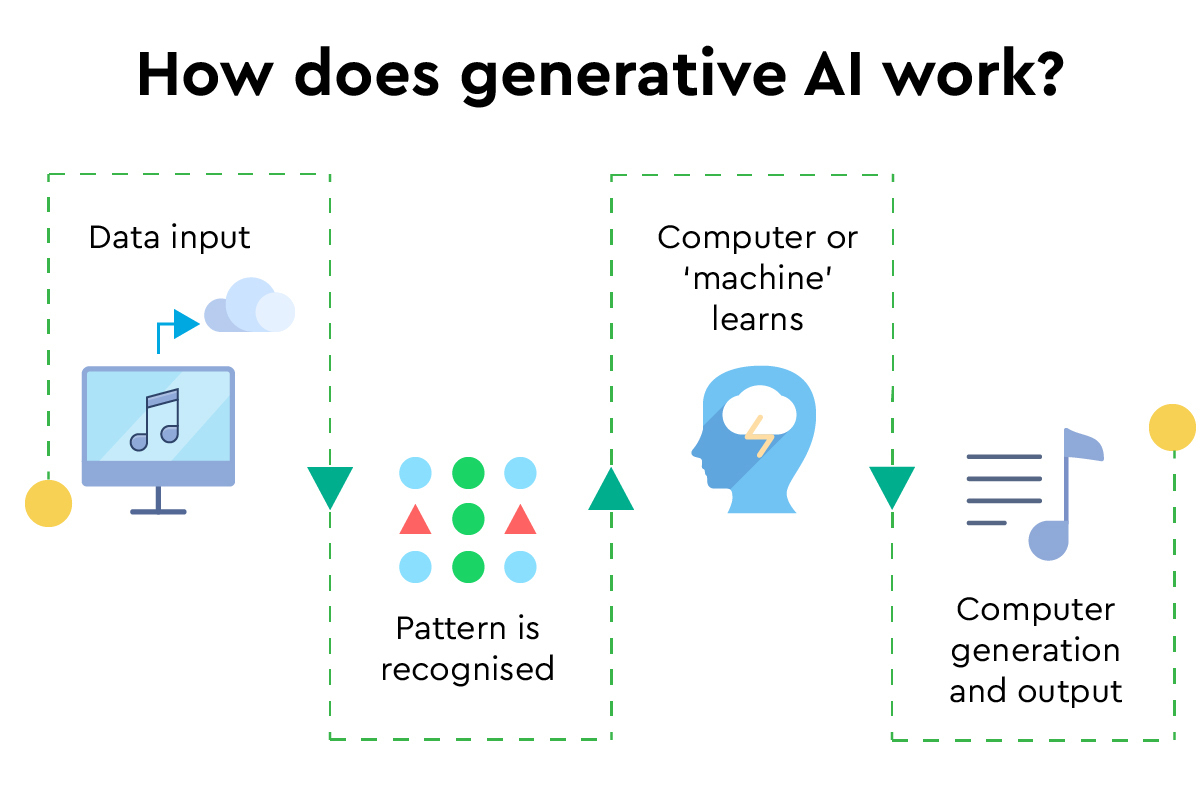
[i] OECD Policy Observatory: What is AI? Can you make a clear distinction between AI and non-AI systems?
[ii] OECD Policy Observatory: Generative AI – Overview
[iii] Soundful: The Ultimate Guide to Generative AI
What is a Biographical Production?
A production which tells the story of the life or work of a particular composer, artist or other music figure or event.
What is a Controversial Theme?
Any theme that APRA reasonably believes to be controversial, including depicting strong violence or sexual abuse, political themes or is derogatory to the work or the artist.
What is a cue sheet?
A Cue Sheet is a record of all songs and compositions used in a film, television, streaming or video game production. You can submit cue sheets via the APRA AMCOS Cue Sheet Portal.
What is a remix?
A remix is a sound recording that has been altered, edited or otherwise reworked to sound different from the original song. A remix typically features some parts or samples of the original recording (even if these samples are altered in any way) together with new material composed by the remixer.
Remixes are commissioned for a number of different reasons. This may be to target a different market e.g. a club remix of a commercial release for DJs to play in nightclubs, a radio friendly remix of a club track for commercial airplay, or even as a launch tool for an up-and-coming artist.
What is an IPI number?
IPI is the acronym for Interested Parties Information.
An IPI is a unique 9-11 digit number that identifies creative right holders as members of collective societies. This number is yours for life when you join APRA AMCOS, even if you join another collecting society or transfer your membership.
What is an ISRC and where can I get one?
The International Standard Recording Code (ISRC) is the international identification system for sound recordings and music video recordings. APRA AMCOS does not issue ISRCs. Recorded Music NZ is the International Standard Recording Code national agency, and it administers ISRCs. For more information about the ISRC system, or to apply for an ISRC for your recordings, please visit Recorded Music NZ.
Please supply all your ISRCs to APRA AMCOS by adding to your works registration details. ISRCs are used by APRA AMCOS to assist in matching work details reported to us by Digital Service Providers for digital download sales. ISRC information therefore assists in maximising the download royalties we can pay to our members.
What is APRA AMCOS's process for licensing music used in Dramatic Context?
APRA AMCOS will examine applications for the show (including the script and programme notes) for evidence of a presentation on the live stage having a storyline, and one or more narrators or characters, or if the production is a Ballet.
If the production is DC APRA AMCOS researches the works, identifies ownership and checks whether any Restricted, Go Direct or other conditions apply.
If there are any works (or shares of works) APRA AMCOS cannot license it will advise the client and provide contact details for the relevant Copyright Owner(s). The client must then liaise directly with the Copyright Owners to clear and license the work/share.
For all remaining works/shares APRA will issue the client with a blanket licence and tax invoice subject to its standard rates, terms and conditions.
APRA AMCOS collects the licence fee and distributes as outlined in the Distribution Rules and Practices documents.
What is copyright and how does it work?
Copyright is a legal right that generally belongs to the original creator of a work.
Copyright protects literary, dramatic, musical and artistic works. It also protects sound recordings, films, published editions, performances and broadcasts. A song may have more than one copyright. The lyrics will be protected as a literary work and the music as a musical work. A recording of the song will also be separately protected as a sound recording.
Generally the composer or author of music or lyrics is the first owner of copyright in the work.
However, if you create music or lyrics as part of your employment, your employer is usually the first owner of copyright.
Similarly, if you create a work under the direction or control of a government body, the government would own copyright in the absence of an agreement to the contrary.
- Commissioned works: If you are commissioned to write music or lyrics, the person who commissioned you does not automatically owns the rights in the work, unless there is an agreement to this effect or unless they are “the Crown”. They will, however, have a right to use the work for the purpose for which it was commissioned. In these circumstances it is advisable to clarify the rights of both parties in a written agreement.
- Works created in collaboration: If you collaborate with others in writing music or lyrics, it is also advisable to have a written agreement clarifying who owns the rights in the resulting work. You may be regarded as joint authors under the law. Failure to clarify ownership at the time may result in lengthy and difficult disputes further down the track.
- Sound recordings: The person who pays for the sound recording to be made will usually be the first owner of copyright in the recording. The performers on the recording may also be joint owners of copyright in recordings. Advice on ownership questions and assistance with drafting these agreements can be obtained from the Copyright Council of New Zealand.
Copyright owners in music and lyrics have a number of exclusive rights.
Anyone who wants to use a protected work in any of the ways outlined below will usually need the copyright owner’s permission. He or she may also have to pay a royalty.
Copyright owners have the right to:
- Reproduce the work: This includes recording the music or lyrics onto a CD, a film soundtrack, or onto a computer disk. It also includes reproducing the music or lyrics as sheet music.
- Publish the work: This means making your work available to the public for the first time.
- Perform the work in public: This includes playing the work live at a venue, playing a recording of the work in a venue, business or work place, and showing a film containing the work.
- Communicate the work to the public: This includes communicating the work over the Internet, via a music on hold system or by television or radio broadcasting.
- Make an adaptation of the work: This includes arranging or transcribing music, or translating lyrics.
- Rent a recording of the music: This is the right to control the rental of recordings (on CD for example) of the work.
In the music industry, these rights are usually grouped in the following way:
- The mechanical right: This is the right to record a work on record, cassette or CD. This is usually administered by either AMCOS or by music publishers.
- The synchronisation right: This is the right to use music on the soundtrack of a film or video and is usually administered in the same way as the mechanical right.
- The performing right: This is the right to perform a work in public or to communicate a work to the public. It is administered by APRA.
There is a separate copyright in the sound recording of a musical work (with or without lyrics). The person or company that owns the rights in the recording owns the right to copy it, record it, perform it, communicate it to the public or rent it out.
Copyright lasts for the life of the author + 50 years
Generally copyright in music and lyrics lasts for the life of the author or creator, plus 50 years after the end of the calendar year in which the author dies.
If the work was not published, broadcast, performed or records of the work had not been offered or exposed for sale to the public until after the creator’s death, copyright will last for 50 years from the end of the calendar year of first publication, broadcast, performance or when records of the work were offered or exposed for sale to the public.
- Print music translations, arrangements and published editions: Where music is arranged or lyrics are translated, there is likely to be a separate copyright in the arrangement or translation. Copyright in these will last for 50 years after the end of the calendar year in which the translator or arranger dies.
- Published editions: Another copyright exists in what is known as the published edition. Published edition copyright protects a publisher’s investment in the typesetting and typographical arrangement of the music and lyrics. Copyright in published editions lasts for 25 years after the date of publication. This copyright may still subsist even when the copyright in the music and lyrics have expired.
When copyright in a work expires, it is in the public domain and anyone can use it without having to obtain permission or pay a fee.
What is Dramatic Context?
Dramatic Context means the performance of musical works:
A) in conjunction with a presentation on the live stage that has:
- a storyline; and
- one or more narrators or characters; or
B) as a Ballet.
What is the ambient music reporting form?
'Ambient’ music is often played in businesses such as acupuncturists, chiropractors, naturopaths, physiotherapists, beauty salons etc. However, because of the nature of these businesses, it's not possible to obtain music use reports.
The Ambient Music Reporting Form allows APRA AMCOS members to report the use of their ambient works by detailing the sale of CDs or downloads to businesses in Australia and New Zealand only.
Your claim will only be eligible if it is accurately deemed the ambient music release was purchased for business use. Sales for private use cannot be reported.
What is the IPI system?
The IPI system is a database that stores all global unique identification of right holders acting across multiple creation classes (musical work, literary work, work of art, etc.), assuming different roles (musical creator, film director, author of fine art, etc.), and owning all rights (performing right, reproduction right, radio broadcast right, etc.), determined by each creation class they deal with.
Is the IPI system an APRA AMCOS database?
No, the IPI system is designed, developed and operated by our international affiliate SUISA and is the backbone administration tool for all collective, intellectual property protection organisations.
What is the process once my Successor in Title (SIT) has submitted their application?
Following receipt of all documentation, the SIT application is presented to our Board of Directors for approval. Once that has occurred, we enter the SIT into our system as an Associate Member, organise for any royalties accrued in your account to be transferred to their account and pay them in the next available distribution. All future royalties will be paid as per our distribution schedule, with the SIT receiving an email to advise that payment has been made.
For more information, or to request an application form, please send us an email.
What is/is not a storyline?
What is a storyline?
A storyline is a chain of events (whether factual, fictional or a combination of both), told in an interrelated sequence or arc (presented in or out of chronological order), within a show (even if a storyline is not written down).
This may include the story of the life or work of a particular composer, or artist or other music figure or event.
What is not a storyline?
Any of the following, on their own, do not constitute a storyline:
- The expression of a theme, idea or topic;
- Anecdotes or ad-libs between the performance of songs;
- A planned sequence of song performances.
What rights does APRA AMCOS control?
We represent performing rights (including communication rights) and reproduction rights for most types of music uses.
What is a performance right?
Songwriters and composers own the right to have their original music performed in public. So…they control the right to:
- play their songs/compositions live at a venue or an event
- play a recording of their songs/compositions in a business, venue or workplace
- have their songs/compositions used in a film or advertisement
What is a communication right?
Songwriters and composers own the right to have their original music communicated to the public. So they control the right to:
- have their song/composition broadcast by television and radio stations
- have their song communicated to the public online
- have their song used via an on-hold telephone system
What is a reproduction right?
Songwriters and composers own the right to have their songs and compositions reproduced or copied. So they control the right to:
- have their music used for a film’s soundtrack
- have their music copied onto a CD, DVD or reproduced online for sale
- have their lyrics and music reproduced as sheet music
What type of events are paid directly via Setlist Submissions?
Major festivals, tours promoted by a National Event Promoter and other large events are directly distributed, which means the event's setlist(s) help us pay the right royalties to all the songwriters whose works were performed. Make sure you provide the Promoter with the setlist for the tour (this can be one setlist for the entire tour or can be a different setlist for each night). Other larger events and organisations also submit setlist for direct payments such as the State Symphony orchestras. If you are asked for a setlist by a promoter or event organiser, it probably means the event will be directly distributed.
If your setlist information is required by us, you'll get event setlist requests directly in your Writer Portal, App notifications, or in the submissions tab when you login and to your email inbox.
When you get a notification, just follow the prompts to submit your setlist direct.
What type of events do I submit a Performance Report (LPR) for?
‘Non-promoted’ shows such as a regular gig at a pub or a show booked directly by the artist.
What will APRA AMCOS do with its AI & Music report?
The findings will be briefed to governments of all levels, showcased to industry and stakeholders, and publicised to media and relevant parties.
We need to ensure there is an urgency to finding a regulatory solution in both territories that can support the Australian and New Zealand music ecosystem.
What's the difference between a 'sound recording' and a 'musical work'?
The copyright of a recorded song has two elements; the sound recording and the musical work. The sound recording information relates to the artist/performer and the record label involved in the recording and production of a song, represented by Recorded Music NZ. The musical work information relates to the songwriter (which can be someone different to the performer) and their publisher; the performance royalties are represented by APRA and the mechanical royalty is represented by either AMCOS, the publisher, or the songwriter, or a combination.
What's the difference between a remix and a cover?
A cover is a performance or new recording of a song that was written and previously performed by someone else. It does not involve any significant changes to the underlying musical work.
A remix is a new song that uses parts or samples of a previously written song. It may also contain new material composed by the remix artist.
What’s the benefit of appointing APRA AMCOS as my Dramatic Context agent?
APRA AMCOS has specialist teams in Australia and New Zealand dedicated to licensing theatrical performances. In addition to being experts in their field, this team relieves Copyright Owners from the administrative burden of processing licensing requests, negotiating licence fees, implementing a licence and ensuring payment is made by licensees.
What’s the benefit of submitting a setlist that has been requested?
The royalty due to the original songwriters from these events can often be higher than payments from submitting a Performance Report (previously Live Performance Return or ‘LPR’).
If you have performed in a promoted concert, watch out for setlist requests in your Portal, App and email. When you get one, just follow the prompts to submit your setlist.
When can I register a remix with APRA AMCOS?
You can register a remix with us after you've obtained written permission from the owners of the original song, and if the remix is original enough to be considered a new musical work. The original owners may be songwriters, music publishers or both.
Before registering the remix, ensure that all owners involved in the remix (including original songwriters, music publishers and remixers) agree to the remix ownership details that you will be supplying to APRA AMCOS. If the copyright owner of the original song does not grant permission for you to claim royalties for your remix, you will not be able to register your remix with us.
Once you have obtained permission and all copyright owners agree on the ownership details, email us a copy of this permission, along with your remix registration details.
You should provide the original copyright owners with details of the ISRC (International Standard Recording Code) and any new performers associated with your remix so that this can be added to the existing APRA AMCOS work registration.
Please be aware that you cannot register or claim APRA AMCOS royalties for cover songs. The royalties for cover songs are paid to the original songwriters and music publishers.
When do I get paid royalties?
APRA pays domestic royalties every three months and processes overseas royalties monthly.
AMCOS processes royalties quarterly—within 60 days of the end of each calendar quarter, usually just before the 60th day. All amounts over $10 are paid.
When do I need to provide a setlist?
If a Promoter or event organiser requests that you provide a setlist, please do! They are requesting this so we can distribute the fee directly to the works that you performed. Otherwise, you should submit a Performance Report.
If in doubt, submit a Performance Report!
If you haven’t been asked to provide a setlist, by the Promoter or by an APRA staff member, please submit a Performance Report for these events. This ensures you are paid for all your performances in Australia and New Zealand.
When will I be paid?
Ambient music claims are generally paid annually in November. Members must submit their ambient music reporting form by 31 August each year to be paid for the financial year ended the previous 30 June.
Where can I get a quote?
Use our rate calculator to get an idea of pricing before you start. Or contact us to get help with a quote.
Where can I go for independent copyright information?
Visit these organisations for more information:
https://www.copyright.co.nz/
https://wecreate.org.nz/
https://www.legislation.govt.n...
Where does the money from licences go?
For every dollar we collect, about 85 cents goes straight back to songwriters, composers and publishers as royalties. The remainder is used to administer these royalties.
As a music rights management organisation, after costs are covered the rest of the money is distributed (paid) to music creators. Our expense-to-revenue ratio compares very favourably to affiliated organisations providing the same service overseas.
Who can join AMCOS?
Joining AMCOS is separate from joining APRA. You may want to join AMCOS if you have unpublished works released on a recording for sale to the public or reproduced in a production music recording. You can join AMCOS if:
- You're a copyright owner of musical works;
- You don't already belong to an overseas mechanical rights organisation;
- At least one of your works is unpublished and has been commercially reproduced eg: available on a digital music service like Spotify or Apple Music, released as a physical product by a third party, or reproduced in a production music recording.
Who can join APRA?
If you write or compose your own songs, you may be eligible to join APRA. You'll also need to match one or more of the following criteria:
- You or someone else performs your songs live OR
- Your songs are broadcast on radio or TV OR
- Your songs are available to stream online.
You can't join if you're a member of an overseas Performing Rights Organisation. If you're in a band, only the members who write or compose music need to join.
Who gets paid for music covers on YouTube?
YouTube has a Content ID system to scan and identify copyright material. This system includes audio and audio-visual fingerprinting technology, as well as melody recognition for cover songs. The first two types of fingerprinting technologies are far more developed and accurate in identifying sound recordings and visual material (such as in films and TV programs). Melody recognition technology is less advanced and often cannot identify the large quantity of cover songs on YouTube.
Copyright owners can still claim their work manually. If a cover song went viral, it would be up to the copyright owner or music publishers to lodge a claim with YouTube.
Who needs a showreels licence?
Agencies, businesses and individuals (freelancers) who create advertisements for clients, audio-visual programs, promos for radio stations, and other clients need a showreel licence if they are using them for promotional reasons on their own website.
When a production or showreel is streamed from an agency's website, the responsibility of 'streaming' i.e. the communication right, falls on the individual or company who owns the website - in the same way a TV station holds a communication licence to broadcast musical works to the public.
Who qualifies for the fees of $100?
Anyone making available online showreels which only contain production music.
Who runs APRA AMCOS?
APRA AMCOS isn't a government body. We're a music rights management organisation run by an executive management team in liaison with a non-executive board of directors. Individual writer members and representatives of publisher members are elected to the board by their respective memberships for renewable three-year terms.
Why am I being asked to provide a setlist by the Promoter of an Event or Festival?
Whenever music is performed in public the songwriter and their publisher may be entitled to a payment or royalty. We need your setlist in order to pay the royalties to the rightsholders whose works were performed at this event. For certain events we collect setlists directly (rather than via a Performance Report) so that we can directly distribute the licence fees. These 'Directly Distributable Events' are paid out at a different rate than other OneMusic licence payments and may attract higher licence fees.
If you have performed at a promoted concert, keep an eye out for setlist requests in via the Writer Portal, Writer App notifications and email. When you get one, just follow the prompts to submit your setlist.
Why do I need to provide a bio and photo?
This information may be published online and/or in print if your application is shortlisted and/or you are a winner.
Will I get paid for international radio or TV broadcasts of my song?
We do monitor overseas TV and radio broadcasts, as well as chart information. However, if you know your music has been used overseas, you should email us [email protected]
Does APRA AMCOS offer any awards, grants or competitions?
APRA AMCOS is committed to supporting and celebrating the artistic excellence and commercial success of songwriters and composers across all genres.
There are several programs, grants, awards, competitions to help you build a thriving career in the music industry.
How do I copyright and register my works?
Copyright and registration are two separate things.
Copyright is free and automatic.
That's right—you don’t have to do anything to ‘get’ copyright; it's there from the moment you write down or record the song. So as soon as you create a new song or piece of music, you have copyright in it.
Register works with APRA AMCOS.
To ensure you receive royalties when your work is played or performed, you must register your songs and compositions through the Writer Portal or App.
How does the Jingle system work?
We use two types of music use reporting for jingle distributions -
- Music recognition technology (for jingles broadcast on New Zealand radio in Auckland, Christchurch & Wellington; and New Zealand TV in Auckland; Australian TV and radio in Sydney, Melbourne, Brisbane, Adelaide & Perth). Upload the audio associated with your jingles in the Writer Portal.
- Jingle self-reporting form (for jingles broadcast in all other areas). If your ad is only played in these non-metro areas, you will need to contact [email protected] to discuss further..
To increase the opportunity for our MRT supplier to successfully recognise music contained within advertisements, please ensure you upload the highest quality MP3 or WAV files available to you.
What are the Professional Development Awards for?
The Awards are intended to help emerging songwriters/composers attend songwriter workshops, music education courses, composer seminars, participate in co-writing opportunities and attend other relevant activities either domestically or internationally. Activities that will develop their career in songwriting/composing.
What is AMCOS?
AMCOS stands for the Australasian Mechanical Copyright Owners Society. We are not a publisher or aggregator. We are the sole Mechanical Rights Organisation (MRO) that licenses musical works to third parties for the Australian and New Zealand territory, and distributes mechanical royalties to writer and publisher members.
AMCOS membership is free to join and remains active throughout your lifetime.
What is OneMusic New Zealand?
OneMusic is a joint licensing initiative between APRA AMCOS and Recorded Music NZ. OneMusic licenses businesses that use music on behalf of APRA AMCOS and Recorded Music NZ, who return the licence fees collected to music creators – songwriters, composers, music publishers, recording artists and record labels – as royalties.
Both are member organisations, which means that after administration costs all money collected is returned to music creators as royalties. Having permission to use music in a business setting is required by law, and a OneMusic licence grants businesses the permission they need to use essentially all commercially released music from anywhere around the world.
What's Production Music?
Production music is written and recorded specifically for the synchronisation or dubbing in production including advertisements, films, DVDs, TV and radio programs, websites, online games, on-hold music and ringtones.
Licences issued by APRA AMCOS cover the right to reproduce the musical work and the sound recording. You pay for your licence once you've completed your production.
When are they due?
Submit your reports year-round, on-the-go via the Writer Portal or the APRA AMCOS for Music Creators App. Download the app for free from the Apple App store, or from GooglePlay for Android.
Who is eligible to vote?
Only full members who have earned royalties during either of the last two financial years are eligible to vote.
These earning requirements apply independently to both APRA and AMCOS. That means that if you're a member of both organisations but have only earned royalties from one company in the last two years, then you can only vote in the election for that company.
Can I discuss my application in more detail with someone before I submit it?
Yes, you can contact us via email [email protected]
Please include your name and contact number.
Can I use it to fund our next album?
The Professional Development Awards are not intended to fund recordings, nor are they intended to fund the purchase of gear for recordings – please consider this before applying.
Can I use it to help promote my work – publicity / music video / advertising campaigns?
No. The Awards are intended to develop your skills as a songwriter or composer, not to pay for professional services to promote your work.
Do I apply for the PDA in New Zealand or Australia?
As an APRA AMCOS Member you can apply for either – dependant on where you are a legal resident. As an example: To enter the New Zealand 2025 PDAs, you must be a citizen or a legal resident in New Zealand for a minimum of 2 years on 1 January 2025.
Do I need a licence for music used in my audio or audiovisual production?
Yes. If you are using music in your audio or audio visual production, you must seek permission from the copyright holders. For the musical work (the composition itself), you will require the permission of the composer (usually represented by a Publisher). For the sound recording of the track you require the permission of the Record Label.
Our AMCOS Production Music licences are unique as we can provide clearance for both the sound recording and the musical work under the one licence. Licence fees are collected and then distributed as royalties to the copyright owners.
How many votes does each member have?
The APRA and AMCOS Constitutions provide that every APRA or AMCOS member who has received any earnings at all over the previous two financial years is entitled to cast one vote in the relevant company’s Board elections and AGM. Members are then allocated one additional vote for every $2,500 “block” of earnings they have received over the last financial year. For example, if a member receives $5,000 in earnings during the previous financial year, they will be allocated 3 votes to use in that year’s Board elections and AGM (one vote for being an “earning member” plus 2 additional votes for the $5,000 in earnings they received).
I've just returned from an international tour. When will I get my royalty payments from each country?
Provided there are functioning societies in the countries you've toured, once you have submitted your Performance Report, we'll submit your claim to our international affiliated societies. Depending on their distribution policies, certain performances may be payable and others won't be payable.
Once the society has verified the performances, any relevant payments will be made in their next available distribution back to us. Payment timeframes can vary, depending on how frequently the society distributes.
Read more about submitting Overseas Performance Reports.
What audio should I be uploading?
If your jingles are broadcast on TV or radio metro areas, you should upload audio files when you register your jingles works in the Writer Portal. You can also add audio files to works later. The audio you need to upload is the part of the ad that contains your work. If the jingle has a tag line from another composer, you must edit this out before uploading your part of the jingle.
If a new sound recording is made for an advertisement (e.g. a sound-a-like, a new arrangement, change of lyrics – think 'The Good Guys' based on 'Good Vibrations' or 'I Like Bing Lee' based on 'I Like Chinese') then it is crucial that the new recording is uploaded (after undertaking any necessary registration steps including obtaining permission from the original writers). This is because the audio fingerprint of the new recording will most likely be substantially different to previous recordings of the musical work.
To increase the opportunity for our MRT supplier to successfully recognise music contained within advertisements, please ensure you upload the highest quality MP3 or WAV files available to you.
What does AMCOS collect?
AMCOS collects reproduction or “mechanical” royalties. These are generated whenever an original musical work is licensed by a third party and commercially reproduced or sold. This includes CD/DVD/vinyl recordings, digital downloads and streaming. Major labels, indie labels and digital service providers (DSPs), such as iTunes and Spotify, are licensed by AMCOS.
It is important to note that AMCOS royalties from digital service providers are a separate income stream from any payments you might receive from your distributor, aggregator or record label.
AMCOS also collects print mechanicals which are generated from the Schools Photocopying Distribution (SPD) and Schools Audio-Visual licences. It's free to join AMCOS - minimal commission costs are deducted from the royalties prior to being distributed to members.
Where does the money come from?
We collect licensing fees from venues that hold live performances on their premises. These licence fees are combined into a “distribution pool”. We allocate royalties from the distribution pool to songs performed at licensed venues using information supplied from Performance Reports.
Am I eligible for AMCOS writer membership?
Joining AMCOS is separate from joining APRA. You may want to join AMCOS if you have unpublished works released on a recording for sale to the public or reproduced in a production music recording. You can join AMCOS if:
- You're a copyright owner of musical works;
- You don't already belong to an overseas mechanical rights organisation;
- At least one of your works is unpublished and has been commercially reproduced eg: available on a digital music service like Spotify or Apple Music, released as a physical product by a third party, or reproduced in a production music recording.
Can a member vote for more than one candidate in the election?
Yes. Members who are eligible to vote in the election may choose to vote for one or more of the candidates in their respective category (i.e. writer candidates or publisher candidates).
Eg: if two writer member Directors are to be elected and seven full writer members have been nominated to stand as candidates, an eligible voting member can vote for a maximum of two of these candidates.
Can I submit Performance Reports if I’m playing overseas?
Please do! Overseas Performance Reports are submitted almost exactly the same way as domestic performances.
Simply log into the app or your Writer Portal online, go to the Submissions tab and when creating a New Submission choose ‘Overseas.’
For performances that occurred overseas you’ll need to add a few extra details such as whether the shows were one-offs or part of a tour or festival, the promoter information, along with some evidence of the show (such as ticket stubs, social media promotion, or letters from venues). This is particularly important for classical, jazz and art music performances.
Do I need a licence to record a cover?
There are a few things you should know about releasing a cover.
Permission
Good news, you don't need permission to release a cover as long as it has already been released by the original copyright owner.
Royalties
Releasing a cover either on a physical product, like a CD or vinyl, or online, requires payment of royalties. If you're represented by a label, they will likely already be covered by a licensing agreement. Check with them to see if you're covered.
Licensing for physical products, like CD or vinyl
For physical releases you need something called an audio manufacture licence, which is available through APRA AMCOS.
Licensing for online release
For online platforms that are already covered by a licensing agreement, like Spotify, you don't need a licence. However, if you plan to release it through an unlicensed platform like your own website, you'll need a licence.
Do I really need to become a publisher member?
Only if you represent other writers’ catalogues do you need to become a publisher member. If you are a songwriter who only represents your own catalogue you should, however, make sure you’ve joined both APRA and, if you are unpublished, AMCOS as a writer member.
How do I find the right music?
With over 1,000,000 APRA AMCOS-controlled production music works to choose from, there's plenty of variety.
All our production music suppliers can help you find what you're looking for. Simply provide them with detailed criteria and they will offer you several options to choose from. See all suppliers.
How much money can I expect to receive from my music being used in the background of a TV program broadcast internationally on cable?
Cable stations are often paid at a lower rate than free-to-air television. The royalty paid will depend on whether the international society has a licence agreement with the specific cable station, and whether they collect music use data from those stations.
If you know your music in a TV program has been broadcast internationally, email us [email protected]. We'll make an enquiry to the relevant societies on your behalf.
I am an APRA AMCOS member. Can I apply for an APRA AMCOS grant to pay for the recording or marketing of my new album?
No, they cannot be used for individual projects. Our music grants can only be used to fund projects and initiatives that support the wider membership.
I'm an artist manager. Can I submit an application on behalf of a songwriter I represent?
You can, but please ensure that you complete all fields with the writer's name and details, not yours. We do also want to hear directly from our writer members about how an Award will support their development, so the responses should come from them.
What happens if I don't upload any audio?
Our jingle system relies on members registering their jingles and uploading the audio in the Writer Portal. Jingle royalty payments are dependent on this registration and audio uploading process.
Can I apply for an APRA AMCOS music grant to financially support my overseas tour?
No. Our music grants are not available to fund individual bands touring domestically or overseas.
Do I have to upload all jingle audio, or only commissioned jingles?
For APRA AMCOS purposes, we classify a ‘jingle’ as any music used in an advertising context. Please ensure that all music that is used in advertisements, both commissioned and non-commissioned works, are registered and uploaded in the Writer Portal.
To increase the opportunity for our MRT supplier to successfully recognise music contained within advertisements, please ensure you upload the highest quality MP3 or WAV files available to you.
I've already released an album and/or have a record deal. Can I apply?
You sure can. The Professional Development Awards are intended to help songwriters and composers move into the next phase of their musical careers. Make sure you use your application to tell us how winning will help you do this.
I’m an APRA writer member, should I join AMCOS?
It depends. If you have a signed agreement with a music publisher, it's not necessary to join AMCOS as any mechanical royalty payments from us are paid to you by your publisher, subject to your publishing agreement. However, if you are unpublished and your music is commercially available (e.g. CDs, digital downloads or streams) it may be generating mechanical royalties. To collect these royalties, you can join AMCOS and we will pay you any relevant royalties directly. Contact us for an AMCOS membership application form.
Is my information secure online?
The PDA application form and all submitted materials are held securely for the duration of the judging process on a highly secure server that ensures privacy and security for all APRA AMCOS data. Your application will only be viewed by select APRA AMCOS staff and the Judging Panel.
My co-writer who is a member of an overseas society has already been paid by their society for overseas performances of our works there. How long will it take for me to get paid?
This may be because the international society has different information in their database about that work. Eg: you may have a work registered 100% to you as the composer/author, but your royalty statement might list your share in overseas earnings as 50%. It's important that advise us if you've signed any publishing agreements, or if there are any other co-writers we are unaware of. If you think you've been underpaid, please contact us.
What if I perform at a corporate or sponsorship gig?
You can submit a Performance Report. This type of performance is in our normal Performance Report parameters and is treated just like any other gig.
What if I'm currently published?
If you are a published writer, you might not need to join AMCOS. It depends on what kind of publishing agreement you have. If your agreement is Specific Works only (ie: it does not cover your entire catalogue) or is specific to a certain territory only (eg: it only covers local mechanicals in New Zealand and Australia) and you have not signed any direct-pay mechanical agreement elsewhere, then it may be a good idea for you to join up to AMCOS so that you are covered for the world for ALL of your works.
However, if your publisher is already an AMCOS member and you have a General Catalogue agreement covering all of your works for the world, then you do not need to join AMCOS at this stage.
It’s important to note that AMCOS writer membership never clashes with any existing publishing agreement. Your publishing agreement will take precedence and AMCOS will cover you for anything else outside of your publishing agreement.
What music can I play under my APRA AMCOS licence?
An APRA AMCOS licence covers the majority of copyright music being played, except:
- Music which is out of copyright. A licence is not required for these works.
- Copyright music where the rights holders have not assigned the performing rights to APRA AMCOS or one of our overseas affiliates.
- “Royalty-free” (or directly-licensed) music where the music is in copyright, but the rights holder does not require the user to obtain any additional licence.
- Music which is specially written for dramatic performances, such as musicals, operettas and ballets (also known as Grand Right works). To use this music, you need to get permission from the rights-holder directly.
If you believe you may be using music which does not require an APRA AMCOS licence, please contact us for further information.
Which directors can a member vote for?
In the APRA Board election, eligible writer members can only vote for those writer members who have nominated to stand in the election of directors (subject to the following conditions):
- Writer members who are Australian residents (or who were resident in Australia at the time of joining as a member) can only vote for Australian writer candidates;
- Writer members who are New Zealand residents (or who were resident in New Zealand at the time of joining as a member) can only vote for the New Zealand writer candidate.
In the APRA Board election, eligible publisher members can only vote for the corporate representatives of those publisher members who have nominated to stand in the election of directors.
In the AMCOS Board election, eligible full members may vote for any nominated candidate they choose.
Does AMCOS act as my Publisher?
No. AMCOS represents some of your reproduction rights, but doesn't act as your publisher.
How do members vote?
In accordance with the APRA & AMCOS constitutions, all eligible members will be asked to cast their votes electronically through the secure login section of the website. Voting will close 7 days prior to the election. There's no voting on the day of the AGM.
A paper ballot will only be distributed to a member if they request this within 5 days of receiving their notice of meeting. All requests for paper ballots should be referred to [email protected].
I am in a band – can the band submit an application?
Applications are only available for individual songwriters – although the band’s music can be considered, the individual songwriter’s application responses will be considered alone. Additionally, the funds will be provided to the individual alone.
I received an overseas performance payment for a work, but the percentage share on my royalty statement looks different to the percentage share I registered with APRA. Why?
This may be because the international society has different information in their database about that work. Eg: you may have a work registered 100% to you as the composer/author, but your royalty statement might list your share in overseas earnings as 50%. It's important that you advise us if you've signed any publishing agreements, or if there are any other co-writers we are unaware of. If you think you've been underpaid, please contact us.
I was told overseas that I need to form a publishing company to collect my mechanical royalties. Is this true?
While in some countries forming a publishing company is necessary to collect your mechanical royalties, this is not required in New Zealand. If you represent your own catalogue, then you can market, promote and exploit it without needing to form a publishing company.
What if I have multiple works in one jingle?
Where multiple works are used in one jingle, only the audio related to your own work/s should be uploaded. Please edit the audio to ensure this is the case and attach the audio to the corresponding jingle registration.
What if I perform on a cruise ship?
You can submit a regular Performance Report via the app or Writer portal.
Where do my APRA AMCOS licence fees go?
We care about ensuring the licence fees you pay are distributed (paid out) to the rights holders in the most accurate and cost-effective way possible.
APRA AMCOS distributes the fees it collects to members as well as international affiliate societies to pay their members. We use different sources of music use data, including direct reporting, sample data and other relevant sources where it's too time consuming or not cost effective to collect and process data from all customers.
Find out more in our Distribution Information Guide.
Who can join as a publisher?
If you're a music publishing company who represents other writers’ catalogues, you can apply to be a publisher member.
Who decides the grant allocation?
Grants are reviewed and determined by the Board Awards and Music Grants Committee and approved at the APRA Board meeting in July/August.
Do we need to submit a Performance Report for each member of my band?
No, you only need to submit one Performance Report per band, per show.
How can I join AMCOS?
Joining AMCOS is separate from joining APRA. You may want to join AMCOS if you have unpublished works released on a recording for sale to the public or reproduced in a production music recording. You can join AMCOS if:
- You're a copyright owner of musical works;
- You don't already belong to an overseas mechanical rights organisation;
- At least one of your works is unpublished and has been commercially reproduced eg: available on a digital music service like Spotify or Apple Music, released as a physical product by a third party, or reproduced in a production music recording.
You can join AMCOS online. Find out more about joining APRA AMCOS.
I have already submitted my application. Can I add supporting material?
We will accept supporting material up to the end of June of the year you apply. Please be advised that this material will not be returned. Any additional material you provide must be clearly marked as supporting material to your named application.
My music is protected by copyright in New Zealand and Australia, how do I protect it internationally?
Works protected under Australian and New Zealand copyright will be protected in most countries of the world – ie those that are members of the International Copyright Conventions and the World Trade Organisation. APRA AMCOS has entered into reciprocal agreements with collecting societies in most of these countries around the world. This ensures that your copyright is protected and royalties are paid on your performances and recordings, according to the distribution rules and practices of each international affiliated society.
Which version of my ad should I upload?
If possible, upload the original music mix used in the ad without any of the ad voice overs. This is enough for our music recognition technology to identify the jingle, even with different voice overs. If you don’t have the original music mix used in ad, then you will need to upload all the different versions of that ad with alternative voice overs.
Who can nominate to become a director?
Any full writer member or the corporate representative of a publisher member may stand for election as a director, providing they are eligible to vote in the election and attend the AGM. This means that only full members who have earned royalties during either of the last two financial years are eligible to nominate to become a director.
Can writer members nominate themselves?
No, an eligible writer member can only be nominated by another full writer or publisher member in the prescribed form (i.e. the official nomination form available from the Company Secretary’s office).
Publisher members can nominate their corporate representative to stand as a candidate in the election of directors.
I'm submitting the Performance Reports for my band, but I didn't write some of the songs. How do I submit these songs?
You submit these songs just as you would any covers played. You will search by the writers’ names when creating your set list and select those works to add to those you are a writer on. You do not need to get different writers to log in and add their songs – only one member of a band should submit a Performance Report!
If I'm an existing member of APRA, how can I join AMCOS?
You may want to join AMCOS if you have unpublished works released on a recording for sale to the public or reproduced in a production music recording. You can join AMCOS if:
- You're a copyright owner of musical works;
- You don't already belong to an overseas mechanical rights organisation;
- At least one of your works is unpublished and has been commercially reproduced eg: available on a digital music service like Spotify or Apple Music, released as a physical product by a third party, or reproduced in a production music recording.
If you are already an APRA member, and you want to join AMCOS, log in to the Writer Portal, go to Account >> My Membership >> Join AMCOS to Learn More.
What if music recognition technology can't match my work?
Our music recognition technology uses retro-matching jingles cycles.
This means that our music recognition technology provider, Soundmouse, will re-attempt recognition for any unrecognised tracks after three, six, twelve, twenty-four and thirty-six months from the first attempt.
To increase the opportunity for our MRT supplier to successfully recognise music contained within advertisements, please ensure you upload the highest quality MP3 or WAV files available to you.
Who can I contact to discuss my application in more detail before I submit it?
Contact Trilby Crowther on 09 623 4720 or email [email protected] with your name and contact number.
Why does it take longer to receive my international royalties than my local royalties?
Each affiliated society has different practices regarding the identification and collection of performance data and the distribution of royalties. Some societies pay us once a year, some twice and some every quarter. If a payment took place at the beginning of the year in a territory that pays once a year, it may be up to two years before we receive the payment, verify its accuracy and forward it on to our member.
When we receive payments for your works from foreign territories, the distributions are processed as quickly as possible to ensure you receive payment promptly.
Can APRA AMCOS be the sole funder of my project?
Our music grants are not intended to be the leading sponsor of any event, program or initiative. We aim to fund activities that support the promotion of the musical works of New Zealand songwriters and composers. The grant application form will ask you to provide evidence (if available) of other financial contributions.
Can I submit Performance Reports if I’m performing a cover song?
Yes! Please include any cover songs in your Performance Reports. This ensures the original writer/s get paid live performance royalties, just as you receive those royalties for your own work.
See also: Performing covers
Does AMCOS collect royalties from digital aggregators?
No. AMCOS does not have any current licensing agreements in place with aggregators. The role of an aggregator is to act as the “middleman” to help you distribute your music globally through digital service providers (DSPs), such as Spotify or Apple Music. The aggregator pays the account-holder directly for any sales or streams. Separately, each sale or stream generates a mechanical royalty. These mechanical royalties are withheld by the DSP. Mechanical rights organisations, like AMCOS, hold licence agreements with DSPs, and collect mechanical royalties directly from them. Royalties are then on-paid to the writers.
Read our Tips for releasing your music online.
If a member is nominated by someone without their knowledge do they have to stand for election?
No. If a member has been nominated to stand as a candidate in the election of directors they must accept the nomination before the cut off date in order to be included on the ballot.
My music has been released internationally on CD. Can AMCOS collect mechanical royalties for me?
Yes. AMCOS is affiliated with numerous mechanical collecting societies around the world, and can collect royalties on behalf of AMCOS members.
What if my jingle has been re-recorded?
If your jingle has been re-recorded, it is crucial that you upload the new recording used in the actual ad. The music recognition technology used generates a fingerprint from the audio file. Therefore always upload the specific recording used each time there’s a re-record.
Do I also need to join an international society if my songs are getting played internationally?
No. We have reciprocal agreements with societies in most territories around the world. If your music is performed publicly or communicated in a foreign territory, the society in that country or territory will collect those royalties and forward them to us to pay our members. The royalties collected and distributed will depend on the distribution practices and procedures of the society in that territory.
If your works have been performed live or broadcast internationally, please email us [email protected], so we can follow up your claim with the relevant international society.
Do I need an APRA AMCOS licence if I only play or copy music from overseas artists?
APRA AMCOS is part of a worldwide network of collecting societies connected through reciprocal licensing agreements. This network allows our members rights to be administered all over the world, and the rights of overseas composers to be represented in New Zealand and Australia. For example, PRSforMusic administers Lorde’s rights in the UK, and we administer Ed Sheeran’s here. Your licence fee contributes income to New Zealand songwriters and to songwriters from around the world.
Does AMCOS collect my synchronisation (sync) royalties?
Yes we can – provided you are an existing AMCOS writer member and the work in question is currently registered in our database. If the work is already registered with APRA but you are not yet an AMCOS member, you can easily join AMCOS. Contact us to request an AMCOS application form. Once your application is processed we will attach AMCOS membership to all of your existing registered works with APRA.
If your work is already registered with APRA, and you're an AMCOS member (or have applied for AMCOS membership), and you'd like AMCOS to administer your sync agreement on your behalf, please send us an email with the details. We'll get back to you and explain next steps.
How many seats are available on the board each year?
The APRA Board consists of six publisher directors and six writer directors (one of which must be a New Zealand writer member).
- Each year two writer directors and two publisher directors must retire from the APRA Board, provided they have served at least three years on the Board. The order of retirement is determined based upon the length of time a director has served in their current term – i.e. those who have been in office longest must retire.
The AMCOS Board consists of 12 directors. There is no defined split between writer and publisher members in the AMCOS constitution.
- Each year four of the AMCOS Board must retire, provided they have served at least three years on the Board. The order of retirement is determined based upon the length of time a director has served in their current term – i.e. those who have been in office longest must retire.
If a director resigns before the end of their term the Board (at its discretion) may appoint another full member to fill this role on a casual basis until the next AGM. If a casual vacancy exists in any given year, this seat will be up for election in addition to the usual number of vacancies created by the retiring directors.
Must I use the grant by 30 June?
Our music grants are awarded as part of an annual financial year cycle. If you do not use your grant by 30 June of the financial year it was awarded, you will need to re-apply for the grant in the next cycle. Grants cannot be carried over to the following financial year.
What if I do an arrangement of a popular work that is still in copyright at my gig?
Unless you have permission from the copyright owners of the work, you cannot claim and be paid for an arrangement of another person’s work. However, you do need to enter this work on your Performance Reports as being written by the original writers so they will be allocated a royalty for your performance of their song.
What if I don't have an audio file for my jingle?
If you've unsuccessfully exhausted every avenue to source the audio for your jingle, you should contact us, and we'll investigate what options are available.
Can I make a variation to my project after the grant has been approved?
Yes, although all variations to the projects must be approved in writing prior to the use. Send an email with your variation request.
How is APRA AMCOS able to license music use?
Whenever music is performed in public, communicated or reproduced the songwriter and their publisher may be entitled to a payment or royalty. The New Zealand Copyright Act gives writers 'economic rights' which cover certain uses of their music. By licensing and allowing the public performance, communication or reproduction of their music, songwriters can generate income known as royalties. Songwriters and their publishers have joined APRA AMCOS and together with our reciprocal arrangements with overseas societies, we are able to aggregate their rights to offer blanket music licences.
How long does a director serve on the board?
In accordance with the APRA and AMCOS constitutions, an eligible member can be elected to the Board for an initial term of three years. After this time they must retire, but if eligible they can nominate to be re-elected by the members for a subsequent term.
If I improvise at my gig, how do I submit these?
You can claim Performance Report royalties for improvisations as long as the musical work is in a material or tangible format - and therefore protected by copyright. The works need to be registered so that you can submit them in your Performance Report.
In addition to the application requirements, what else will I need to do?
Once you are an elected Publisher Member you must submit registrations to notify us of:
- agreements the company has signed with writers or other publishers (publishing and sub-publishing agreements)
- musical works (titles) in which the publishing company or business has a publishing or sub-publishing interest (by virtue of agreements it has signed).
Agreement and work registrations must be submitted in a timely manner. Publisher members may register agreements and works via our Publisher portal. If you are able to create bulk registration CWR files, these can also be uploaded via the portal.
What if my recording is pitched or has a time shift?
Our music recognition technology provider, Soundmouse, has informed us that it's algorithm can cope with pitch/time shifting. However, if you can obtain a copy of the altered recording, we recommend you upload that version anyway.
Will AMCOS collect my mechanical royalties retrospectively?
It depends on when the release was and whether there was a mechanical licence taken out by the third party administering the reproductions.
Eg: if you released a CD album last year through Universal Music, you're unpublished and weren't an AMCOS member at the time, it’s likely a mechanical licence was issued for this release. Send us an email with the details and we'll investigate for you.
If you’re not sure about your specific situation get in touch and we can advise you.
Can I challenge the board decision once it's been made?
The APRA AMCOS Board's decision is final. If you are an applicant, you may request to discuss the outcome with us, however we are not required to provide you with reason for the outcome. Requests for feedback regarding the outcome must be received within 14 days of us advising you that a funding request was declined.
I'm a DJ, should I submit Performance Reports?
Yes! There is a Performance Report form specifically designed for DJs to accommodate the large number of tracks they play in a set. Everything else about the Performance Report for DJs form is the same as the standard form. You can still pre-save set lists, add your tracks one-by-one, or easily search for and add works by other artists.
What are "opt outs"?
AMCOS membership is flexible, allowing writers to opt in or out of specific licensing areas. These licensing areas include:
- Audio and audio-visual recordings (majors)
- Audio and audio-visual recordings (non-majors)
- Ringtones, digital downloads, and more.
If your works generate mechanical royalties in any of these licensing areas and you choose to “opt out” of any one of these areas it will then be your responsibility to collect these mechanical royalties yourself. This can be difficult to achieve for a writer who is unpublished.
We generally advise writers to opt in to all AMCOS licensing areas in the first instance to ensure you are covered for all mechanical collection. You can always change your options later on.
What if I've already uploaded a full ad, including the tag line of someone else's work?
Please provide us with a list of these audio files. You must include details about:
- The unique audio ID – note the default is the file name.
- The original file name (in many cases it will be the same as the default).
- Corresponding JG
Removal requests should be sent via email. You must then re-upload your jingle, ensuring that only that part of the ad with your music is uploaded.
What can't I claim on my Performance Report?
While live performances in public venues in Australia and New Zealand are claimable under the Performance Report system, there are several important exceptions to note.
You cannot claim:
- Private functions: Performances at private functions such as weddings and private parties (even if held in public venues) or nursing homes, hospitals etc. are considered to be private performances in accordance with copyright law. As we cannot issue licences for private performances, we cannot distribute royalties to songs performed at private performances.
- Performances at worship services: We don't license religious worship services.
- Performances broadcast on the radio or television: Live performances broadcast over the radio or television are not considered live performances, they are a 'broadcast'. We distribute royalties for these performances under our normal distribution for TV and radio.
- Dramatic Performances, ballets, musicals, operas: If your music is performed in a live stage presentation that has a storyline and more than one narrator or character, or if it's in a ballet, it is considered a performance in ‘dramatic context’. If works have been written specifically for operas, musical plays or pantomimes etc., it is considered a performance of “Dramatico-musical Works” (or ‘grand rights’ performances). Live performance royalties generated by performance in a Dramatic Context or of Dramatico-musical Works are not claimable under the Performance Report system.
- Busking: Live performances occurring on or after 1 July 2026 in public places such as streets, shopping centres, parks and transport hubs are not claimable under the Performance Report system.
What if I have two separate projects from the one organisation?
You may submit more than one application but they must be on separate application forms.
Why are there so many exceptions?
We provide a range of licences for businesses for different kinds of music use. We can only pay a Performance Report royalty for performances at venues that hold an APRA AMCOS licence specific to hosting live performances. These venues pay licence fees that contribute to the Performance Report “distribution pool”.
Why do I need to supply the terms and conditions of songwriting competitions?
We ask for a copy to ensure that the conditions are in line with APRA AMCOS membership conditions.
I missed out on submitting my Performance Reports for a previous year, can I still get paid for these performances?
The standard claim period for Performance Reports is limited to one year from the date of the performance. It may be extended to up to three years from the date of the performance, where additional evidence (e.g: copies of material advertising the performance, ticket, posters and letters from the venue) is provided in support of the claim.
The extended three-year retrospective claim period is not open to new members. A new member may only claim retrospective performances for the 12 months immediately preceding their date of application.
The App and Writer Portal automatically sets the performance dates you are eligible to claim.
What are my options if I don't agree with how a licence is applied to my business, the fees, of with any of APRA AMCOS' services?
We care about the service we give you and we welcome your feedback. If you would like to comment on our service, email [email protected].
What if I miss the application deadline?
Unfortunately you can't submit an application once the closing date has passed.
Can I change the conditions of the grant once the board has made a decision?
In certain cases variations to your projects may be accepted. All variations must be sent in writing via [email protected]. This must include all aspects that are to be varied (including any new budget). You will be advised if your variation is successful.music
When will I get paid?
Performance Reports are paid quarterly in February, May, August, November.
How long does copyright last, and what's public domain?
When a song is written, the composer is the copyright owner of the work. Where the work is performed, communicated or reproduced the copyright owner is entitled to a royalty payment. The life of copyright in the Australasian territories is 50 years, which means that the composer, their Publisher or their estate is entitled to receive royalties for their work for up to 50 years from the date of their death. Once the 50 years has passed, the work is then in the Public Domain which means it can be used without a fee and without requiring permission from the composer or their estate.
If you would like to check the status of any work please enquire via email.
My funded project is complete. How do I start my acquittal form?
We require music grant recipients to submit a completed Acquittal form two months after the project/event - or no later than 31 May in the financial year of funding (whichever occurs first). If you don't submit a completed acquittal, this may affect future funding opportunities with APRA AMCOS.
How much can I use of a song without having to pay for a licence?
None. There are many myths relating to music copyright. The most common myth we hear is “as long as you only use a small portion of a song, you can use it for free”. The reality is that even for the use of a small portion, especially if the playing of the small portion is identifiable, you require a licence.
What happens if I don't take out a licence?
If you want to play and enjoy essentially any commercially released music from around the world in your business or at your event, it is very likely that you will need to obtain a licence from APRA AMCOS or OneMusic New Zealand. If you are playing our music without our licence, you may be breaching copyright, which, if not rectified, may lead to legal action.
Businesses and organisations that we deal with understand the need to pay music creators for their music and are readily compliant. Of course, we will happily talk with you about your music licensing needs to ensure you are properly covered for the way you are using music.
As you would appreciate, if our music continues to be used without having the right licence in place, then we will be left with no option but to enforce our rights on behalf of our members and affiliates, which could involve court proceedings. Such action may result in the business having to pay the licence fees as well as other damages and legal costs.
Why do I need an APRA AMCOS licence?
Firstly, it shows that your business or organisation respects and supports songwriters and composers - creators of New Zealand culture.
Secondly, if you use music that is protected by copyright within your business, Commonwealth legislation requires permission (a licence) from the creators of that music.
And last but not least - you benefit by using music: keeping your patrons and staff entertained, engaged and creating a better atmosphere.
Composers and music publishers generally authorise APRA AMCOS to administer their rights in Australia. Without these licences you would, for example, need to deal directly with the composers, songwriters and music publishers who own the rights in the music you wish to use.
You can get more information from the New Zealand Intellectual Property Office.
Do I need a licence to film my child's dance concert?
Under our APRA AMCOS licences with primary and secondary schools and OneMusic licence with private dance schools, the school is able to film the concert themselves and share with the school community. They can also give permission to parents to film their child’s concert. However, other permissions may be required, for example in respect of child protection laws as applicable.
While the OneMusic licence with private dance schools only permits the dance school to film the concert, we do have a separate licence that parents can take out themselves. If parents are concerned about copyright they can contact us, but this sort of activity is not the focus of our licensing activities.
Do I need a licence if I record a cover to give away for free?
If you are recording your version of an existing song without changing it in any way you simply need a licence to pay royalties.
If you plan on arranging the work or making any changes to it, you will need to seek permission from the copyright holder first. To find out contact details for rights holders you can search for the copyright owner.
For information regarding releasing a cover online please contact us.
If you wish to enter into a direct agreement with the rights holder please let APRA AMCOS know so that we can check the member arrangement.
Do I need a licence to use music in an online video?
There are separate rights involved when licensing music for an online video.
First you need to seek permission to synchronise the musical work (composition) and master rights (sound recording) to the picture. APRA AMCOS does not have the permission to license synchronisation, so this request must be directed to the rights holders. To find the rights holder/s of a particular work, head to our works search.
Once you have cleared the synchronisation you will need to approach APRA AMCOS for a Communication Licence. This licence covers you for the communication of works online (i.e. the right to “broadcast”). For more information please contact us.
Can I print song lyrics for my choir? Can I print song lyrics on my CD artwork?
If you need to copy, scan, arrange or change a piece of copyright sheet music then you will need permission from the copyright owner to do so. Permission from Publishers is required in all cases. Contact us for assistance.